

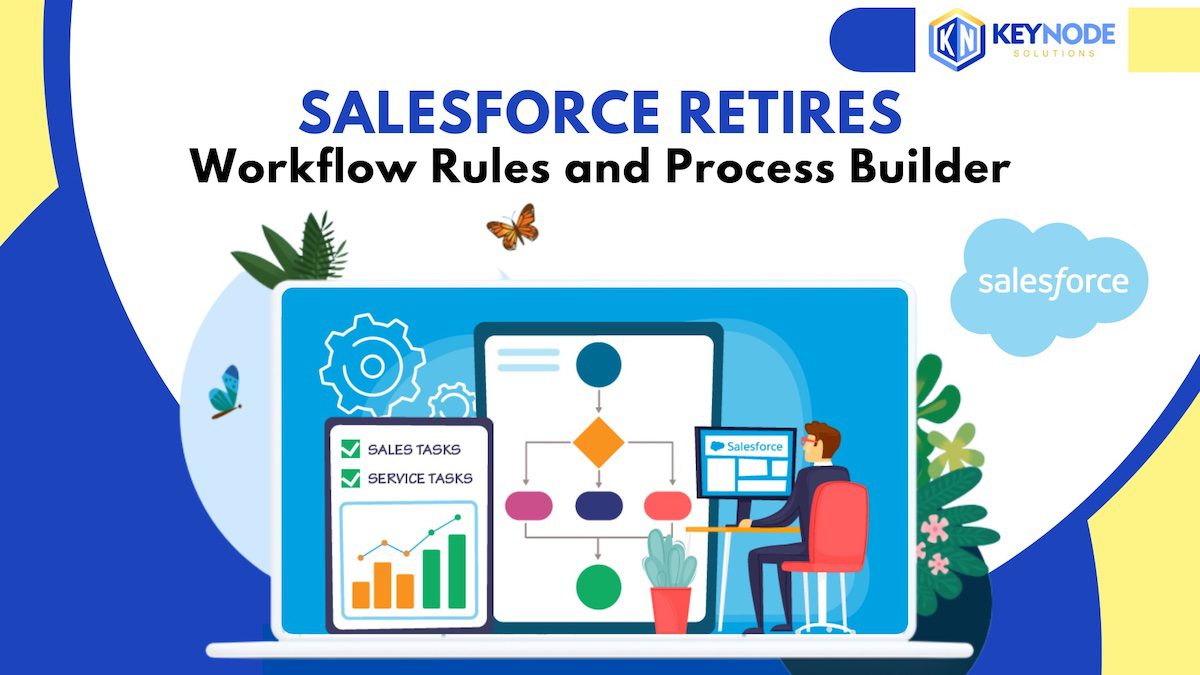
| Update: On December 31, 2025 the Salesforce automation landscape underwent a critical transformation. Salesforce officially announced the end-of-life for its long-standing declarative automation tools, Workflow Rules and Process Builder. This strategic move is part of Salesforce’s effort to consolidate development on a single, modern, and powerful low-code solution: Flow Builder. |
For many Salesforce organizations, Workflow Rules and Process Builder have been the workhorses of business logic for years. They have powered simple field updates, email alerts, and multi-step processes. However, their fragmentation, architectural limitations, and occasional performance issues necessitated a unified path forward.
The End of an Era and the Start of a Migration
The timeline for this transition is firm. While existing Workflow Rules and Process Builders will continue to run for a period, Salesforce will cease providing official support and bug fixes for these features. Furthermore, the ability to create new automations in these legacy tools is being phased out. The deadline for this shift is imminent, underscoring the urgency for all Salesforce customers to develop a comprehensive migration strategy.
The message from Salesforce is clear: all new automation should be built in Flow Builder, and existing automations must be migrated to avoid running on an unsupported platform. If you are unfamiliar with Flow Builder, contact the US-based team of Salesforce Consultants at KeyNode Solutions to learn more about this transition and how we can help you.
Why Flow Builder is the Future of Automation
The move to Flow Builder is more than just a required update; it’s an opportunity to modernize your processes and leverage significantly enhanced capabilities. Flow Builder represents a massive leap in automation power, offering features that were simply not possible in the legacy tools:
- User Interaction: Unlike its predecessors, Flow enables the creation of Screen Flows, which guide users through complex, multi-step processes via a custom interface.
- Greater Flexibility and Complexity: Flow can handle intricate business logic, including loops, collections and complex data manipulation, often removing the need for custom Apex code.
- Superior Performance: Flow Builder, especially with its ‘Before Save’ record-triggered flows, executes far faster and more efficiently than Process Builder, greatly reducing the risk of hitting system limits.
- Advanced Features: Flow supports record deletion (a major limitation of Process Builder), robust error handling, scheduled triggers, and the ability to easily integrate with external systems via HTTP callouts.
Action Steps for Salesforce Admins and Developers
If your organization relies on Workflow Rules or Process Builder, now is the time to act. Delaying the migration only increases technical debt and future risk.
- Inventory Your Automations: Audit your org to identify all active Workflow Rules and Process Builders. Salesforce provides tools, like the Flow Migration Tool (in beta), to help simplify this discovery.
- Plan and Consolidate: Review the identified processes. Eliminate any that are redundant or obsolete. Best practices recommend consolidating multiple automations into a single, object-specific Flow to optimize the order of execution and overall performance.
- Utilize Migration Resources: While the automated tool is useful for simple Workflow Rules, complex Process Builders often require a manual, strategic rebuild within Flow Builder to ensure the logic is optimized and adheres to best practices.
- Upskill on Flow: Admins and developers must embrace the Flow Builder methodology. Trailhead and community resources are vital for understanding flow types, debugging, and performance best practices.
The retirement of Workflow Rules and Process Builder marks a significant evolution of the Salesforce platform. By embracing Flow Builder, organizations can future-proof their automation, boost system performance and unlock a new level of process flexibility.
The dedicated team of Salesforce experts at KeyNode Solutions uses a combination of extensive experience and AI to help effectively solve issues in reduced time and cost. If you have any questions about the transition to Flow Builder contact us at hello@keynodesolutions.com or call us at 1-858-215-5371.
About the Author

Gregory Magaril is the founder and CTO of KeyNode Solutions, driving the company’s mission to turn Salesforce into a revenue-accelerating backbone for growing organizations. A seasoned technology executive with decades of experience across business strategy, cloud platforms, and CRM-led transformation, Gregory blends practical tech chops with a results-obsessed mindset. Like everyone at KeyNode, Gregory is deeply involved in delivery and holds 10+ Salesforce certifications, ensuring strategy is always grounded in real-world execution. Under his leadership, KeyNode delivers tailored Salesforce implementations, automations, and managed services that help teams scale smarter — not harder — and unlock measurable business value. You can learn more about Gregory at https://www.linkedin.com/in/magaril/.
 KeyNode Solutions is a full-service Salesforce Consulting Partner company. We deliver the ultimate Salesforce solutions to grow your business: implementation, integration, customization, and development. Our best-in-class Salesforce managed services for ongoing support available nationwide.

Salesforce Winter ’27 – The Top Features
The next Salesforce release is fast approaching, with releases being scheduled on Sept 4, Oct 2nd and Oct 9th. Being the release just before Dreamforce, it’s jam-packed with lots of great new features. Once [...]

Salesforce Summer ’26 – The Top Features
The next Salesforce release is coming soon, with releases being scheduled on June 5, 12, and 13th. This release is packed with lots of great new features and still contains a heavy emphasis on [...]

How Salesforce Service Cloud Transforms Customer Support Operations
Customer expectations have never been higher. Today’s customers demand fast responses, personalized interactions and consistent service across every channel. Organizations that rely on disconnected systems and manual processes struggle to keep up. To stay [...]
Measuring & Improving Customer Support Performance with Salesforce Analytics
Customer support leaders face increasing pressure to deliver faster service, higher satisfaction and consistent performance across teams. Without accurate data and real time visibility, it becomes difficult to identify gaps, manage workloads and drive [...]

Using Salesforce to Deliver Omnichannel Customer Support at Scale
In today’s connected world, customers expect fast and consistent support across every channel. Whether they reach out through email, phone, chat, social media or self service portals, they want seamless interactions without repeating information. [...]

How Salesforce Automation and AI Reduce Support Response Times
Fast response times are critical to delivering exceptional customer service. In a digital first environment, customers expect immediate answers and seamless interactions across every touchpoint. Long wait times and delayed resolutions can quickly erode [...]