


Salesforce’s Agentforce (formerly known as Einstein SDR, Coach and Service Agent) is a pioneering platform empowering businesses to deploy fully autonomous AI agents—driven by large language models (LLMs) and Large Action Models (LAMs)—that can reason, act and execute tasks directly within CRM workflows. These “digital laborers” boast capabilities from sending multilingual outreach emails to scheduling appointments, answering knowledge questions and summarizing interactions.
Transforming Sales Outreach and Coaching
A flagship use-case is the Agentforce SDR (Sales Development Rep) agent: operating via email, SMS and WhatsApp, it autonomously sends prospecting emails, nurtures leads, handles objections and books meetings—all while leaning on CRM data to stay contextually accurate and uphold compliance standards. Equally compelling is the Sales Coach agent, which simulates buyer–seller scenarios, role-playing discovery calls, negotiating deals and giving feedback—all grounded in real CRM records.
This shift toward autonomous agents is already reshaping seller workflows. Salesforce’s own sellers have shared how Agentforce tools help them quickly research industry specifics (e.g., EV charging), prepare for meetings and strengthen strategic interactions without losing the human touch.
Addressing Common Pain Points
There are Salesforce experts that highlight friction points—like inconsistent AI behavior, lack of guardrails or scarcity of user-friendly customization—and how Agentforce addresses them. Businesses configure settings such as permitted topics, engagement cadence, tone and actions (e.g., booking meetings only when human approval is granted). This level of control ensures that agents enhance rather than replace human efforts, seamlessly handing off complex tasks or off-track interactions back to humans with summaries and agendas included.
Salesforce continues to release updates to facilitate greater visibility and control of AI Agents. In June 2025, Salesforce announced Agentforce 3, with a specific purpose of a major upgrade to its digital labor platform that gives companies the visibility and control to scale AI agents without compromise. As enterprise adoption accelerates, the real blocker has become clear: teams can’t see what agents are doing — or evolve them fast enough. Agentforce 3 changes that by delivering the complete visibility, secure tool integration and enterprise-grade controls organizations need to make agent velocity their competitive advantage.
Voice, API Extensibility and Future Directions
Salesforce is already expanding Agentforce into voice. The Sales Coach can convert text to speech during role-play simulations. Likewise, its Agent API and Messaging API enable developers to build “headless” or multi-agent orchestrations—moving beyond chatbots to deeply integrated, cross-platform business processes.
Looking ahead, Salesforce envisions agents operating in healthcare, finance and deeper customer-service roles—handling tasks like automating nurse documentation, patient check‑ins and EMR searches by 2030. Agents could increasingly work in tandem: one organizes meeting schedules while another ensures communications comply with legal or ethical standards.
Major Shake-Up in Pricing Model
In May 2025, Salesforce introduced a flexible pricing overhaul to align costs with usage and deliver greater predictability. Key updates include:
- Flex Credits: a consumption-based model where each “action” (e.g., retrieve case, update record) uses flex credits at ~$0.10 per action (20 credits), replacing the prior $2 per “conversation” model.
- New license options: User-based subscriptions (per-user per-month) offering unlimited agent use across employees and departments—rolling out Summer 2025.
This more flexible billing approach reduces entry barriers and ties spending directly to measured business outcomes, a big win for ROI tracking.
Conclusion: A New Dawn in Digital Labor
Agentforce represents the third wave of AI in enterprise—beyond analytics and copilots—where autonomous agents act as integrated collaborators. By embedding decision-making within Salesforce workflows and aligning pricing to usage, it empowers sellers, service agents and entire departments to scale. With future enhancements in voice, multi-agent coordination and industry-specific intelligence, Salesforce is reshaping how human and digital workers collaborate.
Businesses embracing this “agent-first” strategy stand to redefine efficiency, freeing employees to focus on strategic, high-value work—while AI partners handle the routine, repetitive tasks. To learn more about Salesforce’s continued integration with AI, contact us at hello@keynodesolutions.com or call us at 1-858-215-5371.
 KeyNode Solutions is a full-service Salesforce Consulting Partner company. We deliver the ultimate Salesforce solutions to grow your business: implementation, integration, customization, and development. Our best-in-class Salesforce managed services for ongoing support available nationwide.

Salesforce Winter ’27 – The Top Features
The next Salesforce release is fast approaching, with releases being scheduled on Sept 4, Oct 2nd and Oct 9th. Being the release just before Dreamforce, it’s jam-packed with lots of great new features. Once [...]

Salesforce Summer ’26 – The Top Features
The next Salesforce release is coming soon, with releases being scheduled on June 5, 12, and 13th. This release is packed with lots of great new features and still contains a heavy emphasis on [...]

How Salesforce Service Cloud Transforms Customer Support Operations
Customer expectations have never been higher. Today’s customers demand fast responses, personalized interactions and consistent service across every channel. Organizations that rely on disconnected systems and manual processes struggle to keep up. To stay [...]
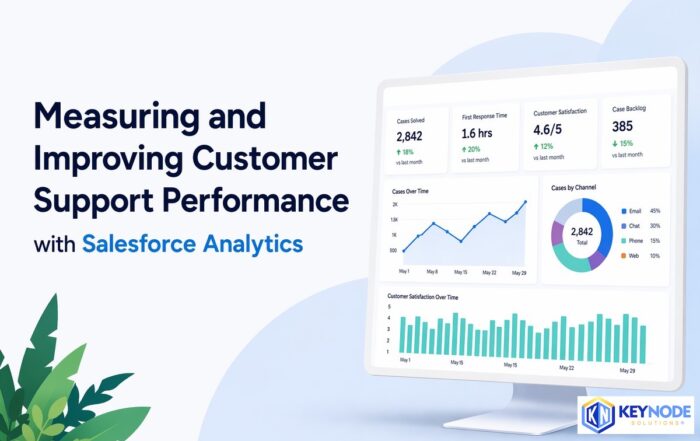
Measuring & Improving Customer Support Performance with Salesforce Analytics
Customer support leaders face increasing pressure to deliver faster service, higher satisfaction and consistent performance across teams. Without accurate data and real time visibility, it becomes difficult to identify gaps, manage workloads and drive [...]

Using Salesforce to Deliver Omnichannel Customer Support at Scale
In today’s connected world, customers expect fast and consistent support across every channel. Whether they reach out through email, phone, chat, social media or self service portals, they want seamless interactions without repeating information. [...]
How Salesforce Automation and AI Reduce Support Response Times
Fast response times are critical to delivering exceptional customer service. In a digital first environment, customers expect immediate answers and seamless interactions across every touchpoint. Long wait times and delayed resolutions can quickly erode [...]